Open WebUI
Open WebUI is a modern, open-source chat interface that supports OpenAI-compatible APIs. By adding DeepIntShield as a connection, you get access to any model configured in DeepIntShield through a familiar ChatGPT-like interface, plus governance features like virtual keys and built-in observability.
1. Install Open WebUI
Section titled “1. Install Open WebUI”Follow the Open WebUI documentation for installation. Open WebUI can run via Docker, Docker Compose, or Kubernetes.
2. Add DeepIntShield as a Connection
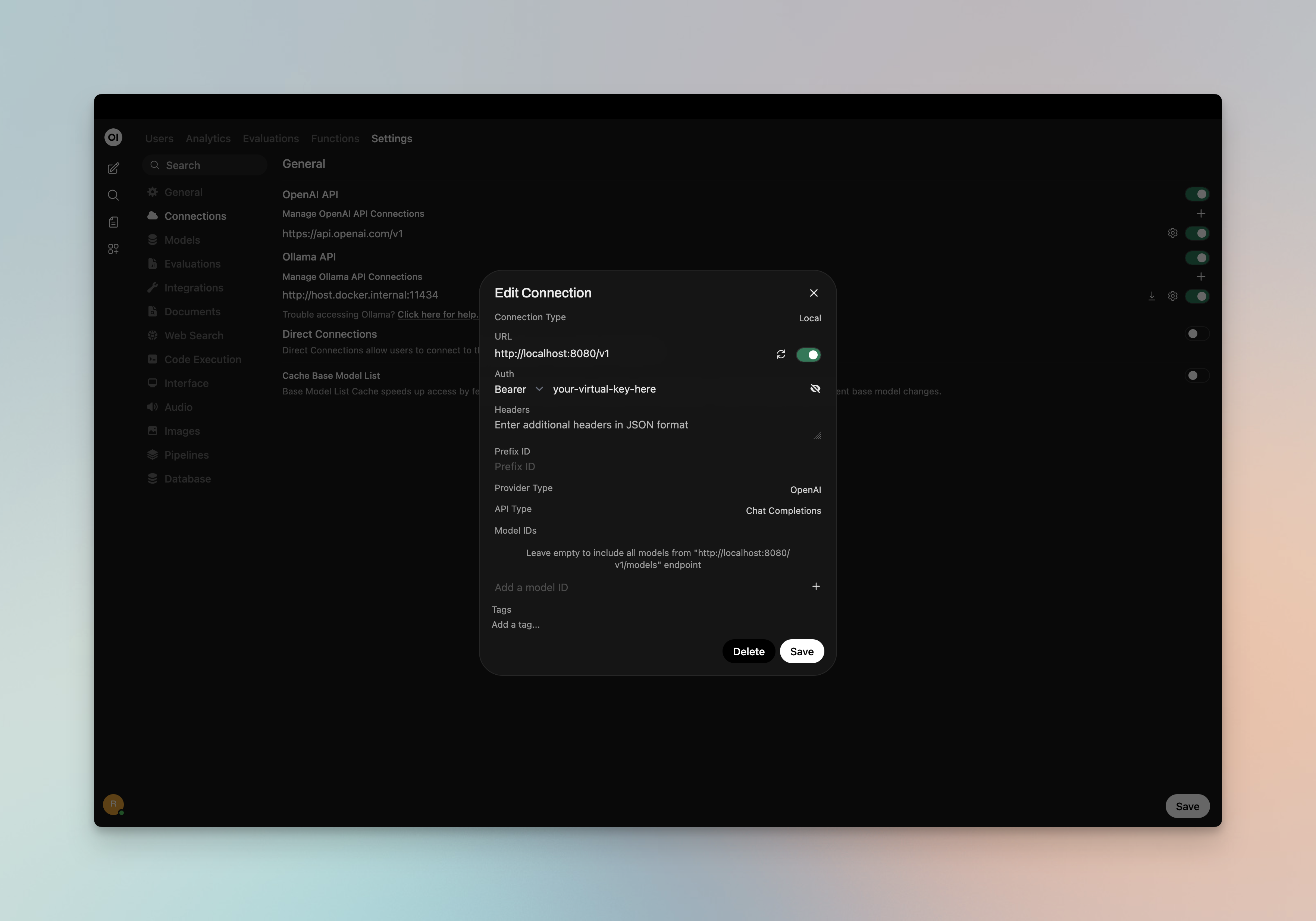
Section titled “2. Add DeepIntShield as a Connection”- Open Open WebUI in your browser
- Go to ⚙️ Admin Settings → Connections → OpenAI
- Click ➕ Add Connection
- Configure the following:
| Field | Value |
|---|---|
| URL | http://localhost:8080/v1 (or your DeepIntShield host, e.g. https://deepintshield.yourcompany.com/v1) |
| API Key | Your DeepIntShield virtual key if authentication is enabled; otherwise leave empty or use dummy |
- Click Save
3. Model Discovery
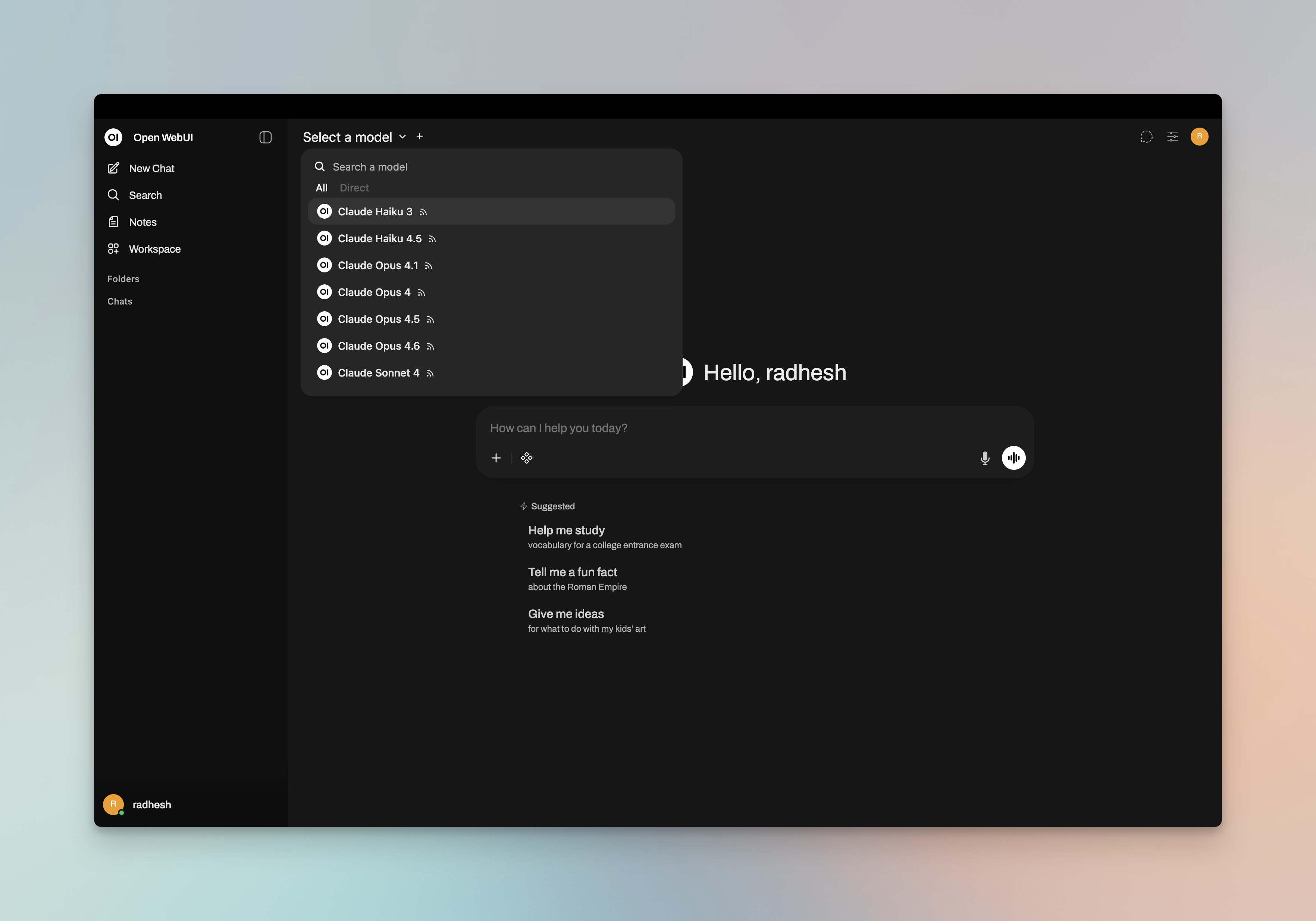
Section titled “3. Model Discovery”Open WebUI fetches available models from DeepIntShield’s /v1/models endpoint. If auto-detection fails or you want to filter which models appear, add model IDs to the Model IDs (Filter) allowlist in the connection settings. Use DeepIntShield model IDs in provider/model format (e.g. openai/gpt-5, anthropic/claude-sonnet-4-5-20250929).
4. Start Chatting
Section titled “4. Start Chatting”Select your DeepIntShield connection’s model from the chat model selector and start chatting.
Virtual Keys
Section titled “Virtual Keys”When DeepIntShield has virtual key authentication enabled, set API Key in the connection to your virtual key. This lets you enforce usage limits, budgets, and access control per user or team.
For team deployments, create separate Open WebUI connections (or use different API keys per connection) — each virtual key can have its own rate limits, budgets, and provider access rules configured in the DeepIntShield dashboard.
Model Selection
Section titled “Model Selection”Open WebUI displays models fetched from DeepIntShield or those you add to the Model IDs allowlist. Use DeepIntShield model IDs in provider/model format to access any configured provider:
- Use powerful models like
openai/gpt-5oranthropic/claude-sonnet-4-5-20250929for complex conversations - Use fast models like
groq/llama-3.3-70b-versatilefor quick responses
Using Multiple Providers
Section titled “Using Multiple Providers”DeepIntShield routes requests to the correct provider based on the model name. Use the provider/model-name format to access any configured provider through the single /v1 endpoint:
anthropic/claude-sonnet-4-5-20250929openai/gpt-5gemini/gemini-2.5-promistral/mistral-large-latestSupported Providers
Section titled “Supported Providers”DeepIntShield supports the following providers with the provider/model-name format:
openai, azure, gemini, vertex, bedrock, mistral, groq, cerebras, cohere, perplexity, xai, ollama, openrouter, huggingface, nebius, parasail, replicate, vllm, sgl
Multimodality
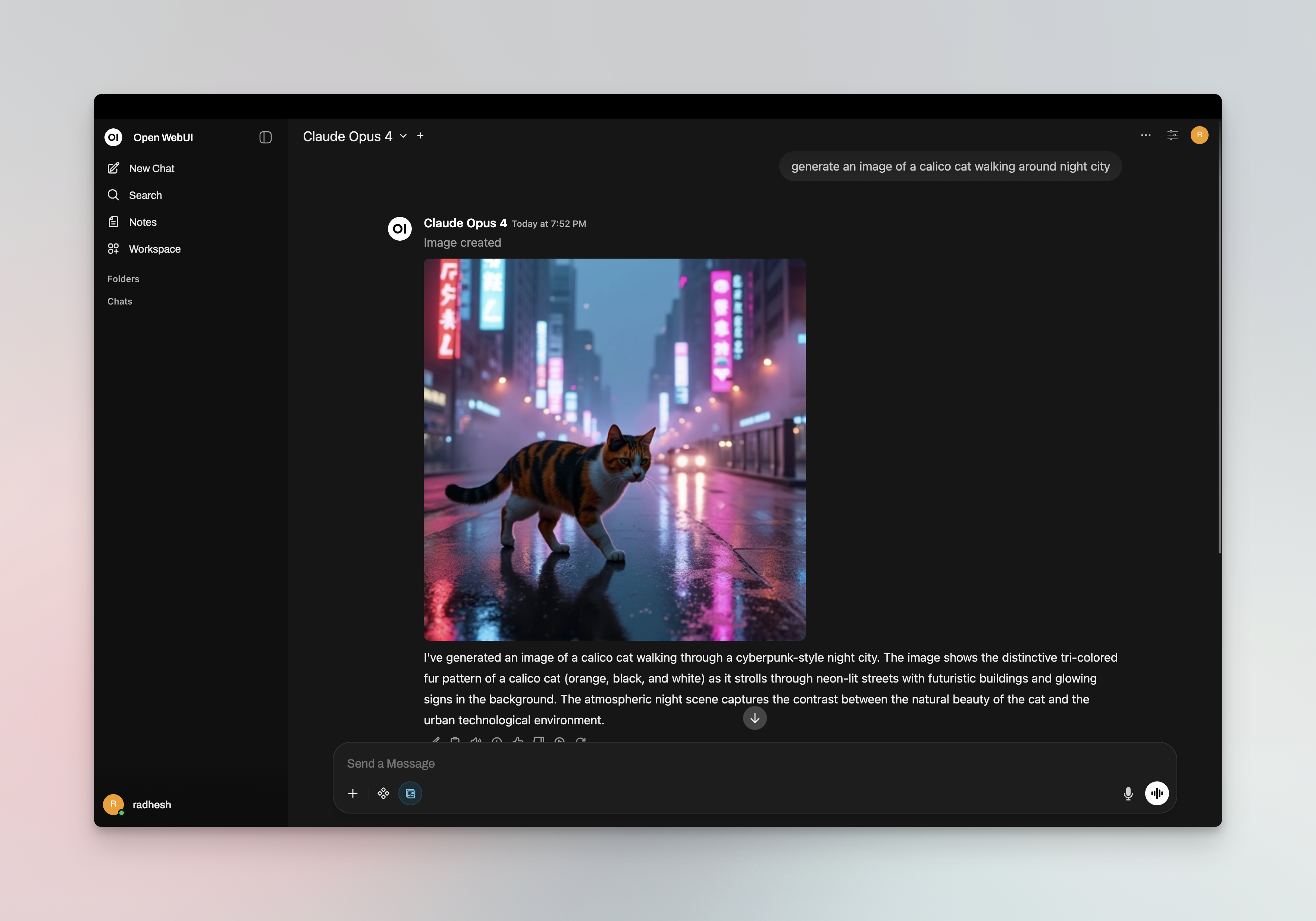
Section titled “Multimodality”Open WebUI supports image generation and vision (image understanding). You can use DeepIntShield for both.
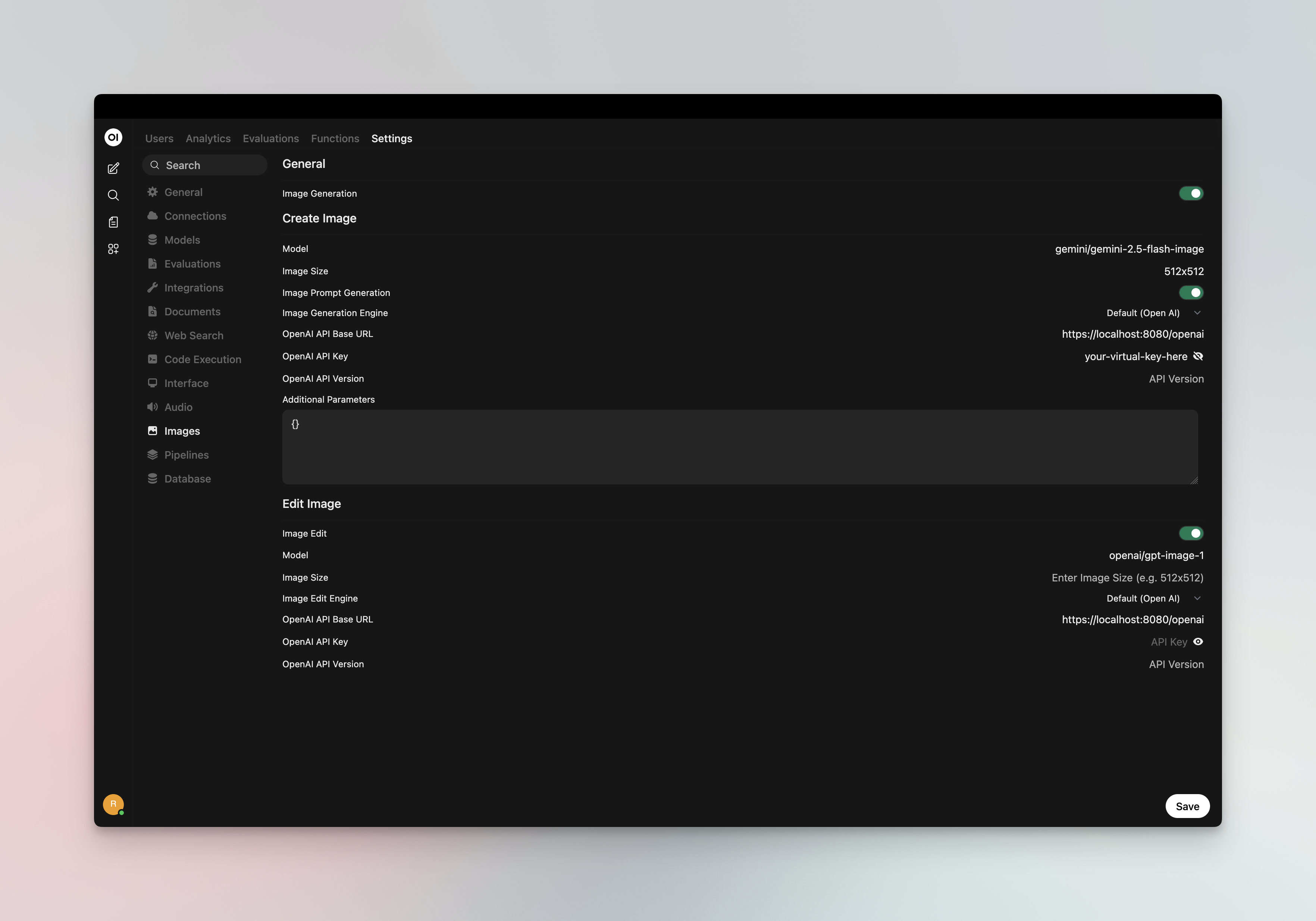
Image Generation
Section titled “Image Generation”Set a DeepIntShield provider/model as your image inference engine for DALL·E-style image generation:
- Go to ⚙️ Admin Settings → Settings → Images
- Set Image Generation Engine to Open AI
- Configure:
- API Endpoint URL:
http://localhost:8080/v1(or your DeepIntShield host +/v1) - API Key: Your DeepIntShield virtual key if authentication is enabled
- Model: DeepIntShield model ID in
provider/modelformat (e.g.openai/dall-e-3,openai/gpt-image-1)
- API Endpoint URL:
DeepIntShield routes image generation requests to the configured provider. Use any image-capable model in your DeepIntShield configuration (OpenAI DALL·E, GPT-Image, or other providers that support /v1/images/generations).
Vision (Image Understanding)
Section titled “Vision (Image Understanding)”Chat models that support vision (e.g. openai/gpt-4o, anthropic/claude-sonnet-4-5) work through your main DeepIntShield connection. When you select a vision-capable model in the chat selector, you can attach images to your messages — Open WebUI sends them to DeepIntShield, which routes to the correct provider.
Docker Networking
Section titled “Docker Networking”Choose the correct URL for your setup:
| Setup | URL |
|---|---|
| Open WebUI and DeepIntShield on same host | http://localhost:8080/v1 |
| Open WebUI in Docker, DeepIntShield on host | http://host.docker.internal:8080/v1 |
| Both in same Docker network | http://deepintshield-container-name:8080/v1 |
Environment Variables (Alternative)
Section titled “Environment Variables (Alternative)”You can also configure DeepIntShield via environment variables when running Open WebUI:
# Single connectionOPENAI_API_BASE_URLS="http://localhost:8080/v1"OPENAI_API_KEYS="your-deepintshield-virtual-key"
# Multiple connections (semicolon-separated)OPENAI_API_BASE_URLS="http://localhost:8080/v1;https://other-gateway.com/v1"OPENAI_API_KEYS="key1;key2"
Observability
Section titled “Observability”All Open WebUI traffic through DeepIntShield is logged. Monitor it at http://localhost:8080/logs — filter by provider, model, or search through conversation content to track usage across your team.
Next Steps
Section titled “Next Steps”- Provider Configuration — Configure AI providers in DeepIntShield
- Virtual Keys — Set up usage limits and access control